Nest boxes for the South West Goulburn

Six box designs for the animals between Broadford and Seymour, drawn as full size cutting templates. Print the sheets at a plan printer, glue them to a board of plywood, cut on the lines. No marking out, and nothing to buy beyond the board, screws, paint and a piece of rubber.

Why we drew them

A eucalypt has to be old before an animal can live inside it. A hollow big enough for a pardalote or a small bat takes a tree of 70 to 100 years. One big enough for a phascogale, a glider or an owl is rarely found in a tree younger than about 220 years, so the big hollow trees in paddocks between Broadford, Kilmore, Pyalong, Tallarook and Seymour were growing when Hume and Hovell crossed the Goulburn in 1824. Most of their generation has been cleared. Nothing planted in living memory is old enough to take their place.

Then came January 2026. Bushfires burnt through the country north and east of the network, in the Murrindindi and Mansfield shires, and large hollow-bearing trees went with the fences and the sheds. Kinglake Landcare Group set out in September to build about fifty boxes for fire-affected landholders. We want to add to that, with boxes built by the people who have the tools to build them well: schools with a woodwork room, Men's Sheds, landholders with a bench, plywood shops with a CNC router.

Two animals carry the argument here. The Brush-tailed Phascogale and the Squirrel Glider are both listed as vulnerable in Victoria, both recorded in Mitchell Shire in the last three years, and both move into a plywood box built and placed properly. Krefft's Glider, the Australian Owlet-nightjar, the Striated Pardalote, microbats and several parrots use them too. A box is not a hollow. It runs hotter in summer, it lasts ten to twenty years rather than a century, and bees take some. It is still the only thing anyone can do this decade for an animal needing a hole in a tree. The Whroo Goldfields programme north of Seymour, about a thousand boxes checked every year since 2009, saw occupancy rise from 30 per cent of boxes in 2011 to 59 per cent in 2017.

How the kit works

Each design is a full size A0 sheet. Print it at a plan printer at 100 per cent, check the printed metre bar, trim on the dashed line, glue it straight onto 17 mm structural plywood. Cut on the printed lines, drill on the cross hairs, read the assembly order off the panels. Three sheets cover one 2400 by 1200 board and give three to nine boxes, with the fixing battens cut from the slack. A school buying two boards hands us a dozen boxes.

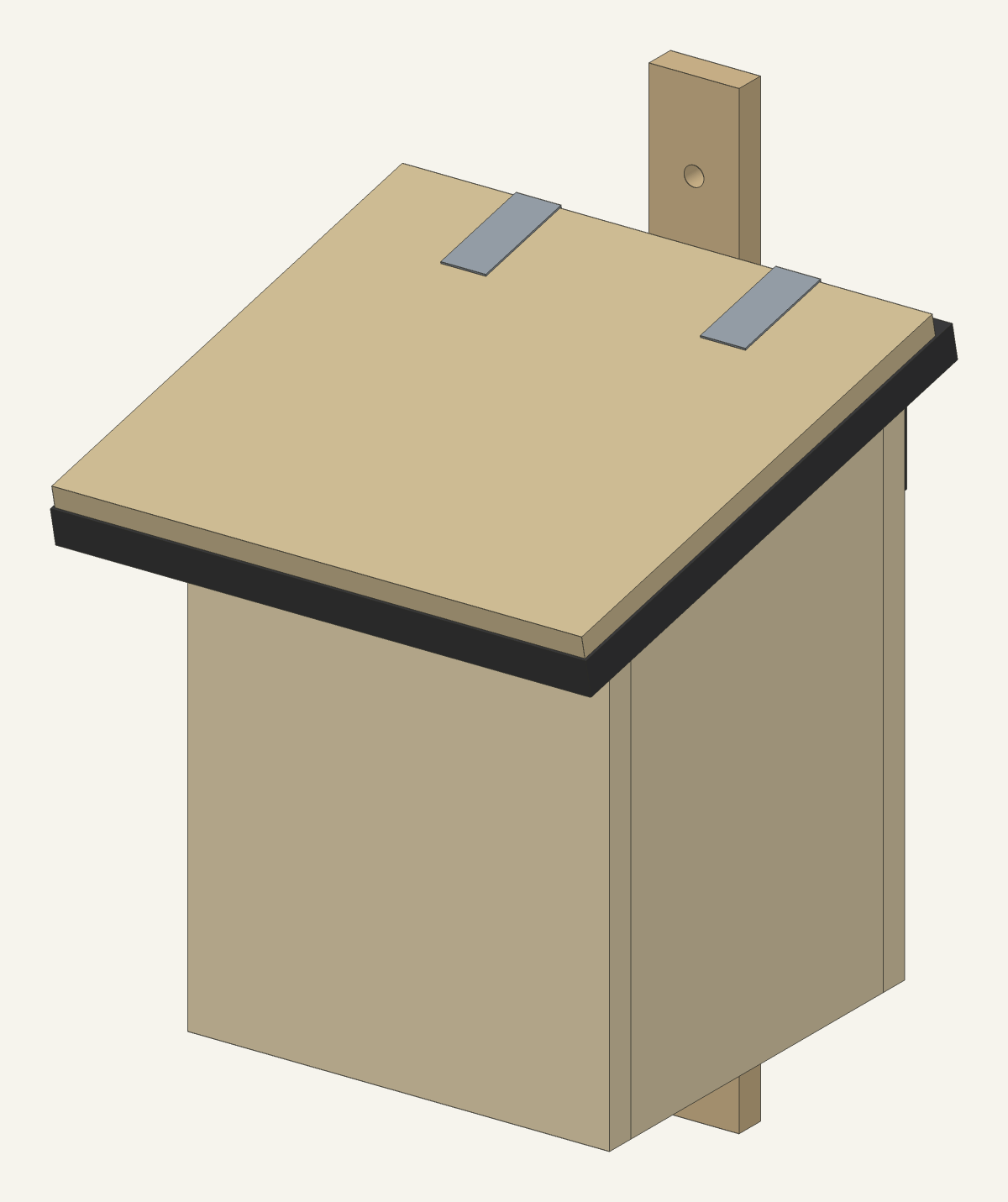
The details are where boxes fail, so the drawings settle them. Every lid is three layers: the plywood lid, a sheet of rubber glued over it and folded down the back as the hinge and the weather seal, then a thin plywood cap on top to shade the rubber and keep parrots off it. There is no hinge to buy and no catch to undo from a pole. One batten down the back with two stainless coach screws holds the box 17 mm off the bark, and on the phascogale box that gap is the doorway. Saw kerfs inside the entrance wall are the ladder out, never mesh. Pale paint outside, three coats, nothing inside, because a dark box in this district reaches the low fifties. Every dimension traces to a published source, listed in the specification.

The six boxes

Every entrance except the kookaburra's is 70 mm or smaller, the size which keeps a Brushtail Possum out. Where one carcass suits several animals the template prints the hole sizes as concentric circles with the animal named beside each, and the builder drills one. Each model below turns on its own. Drag it to look where you like.

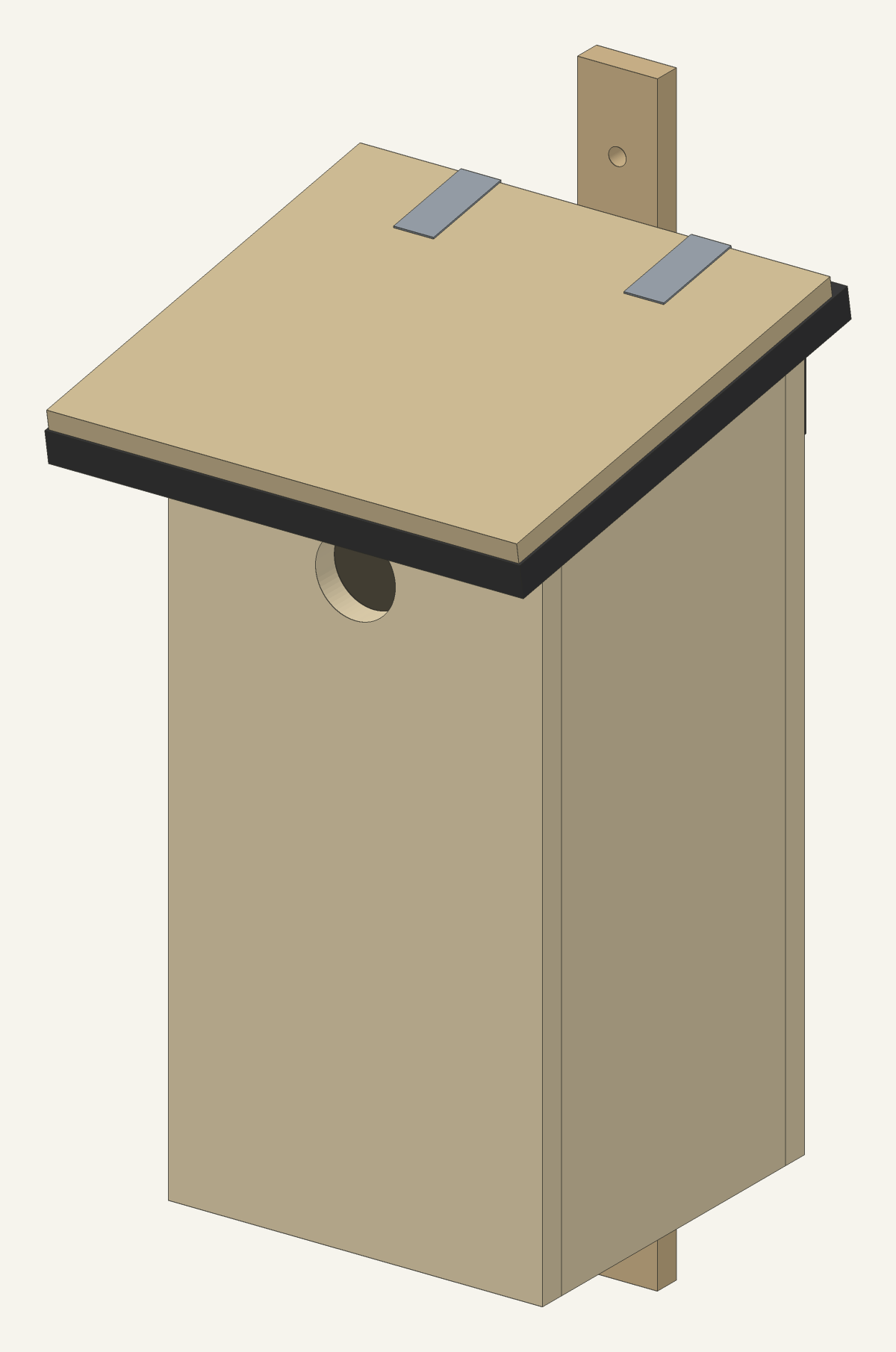
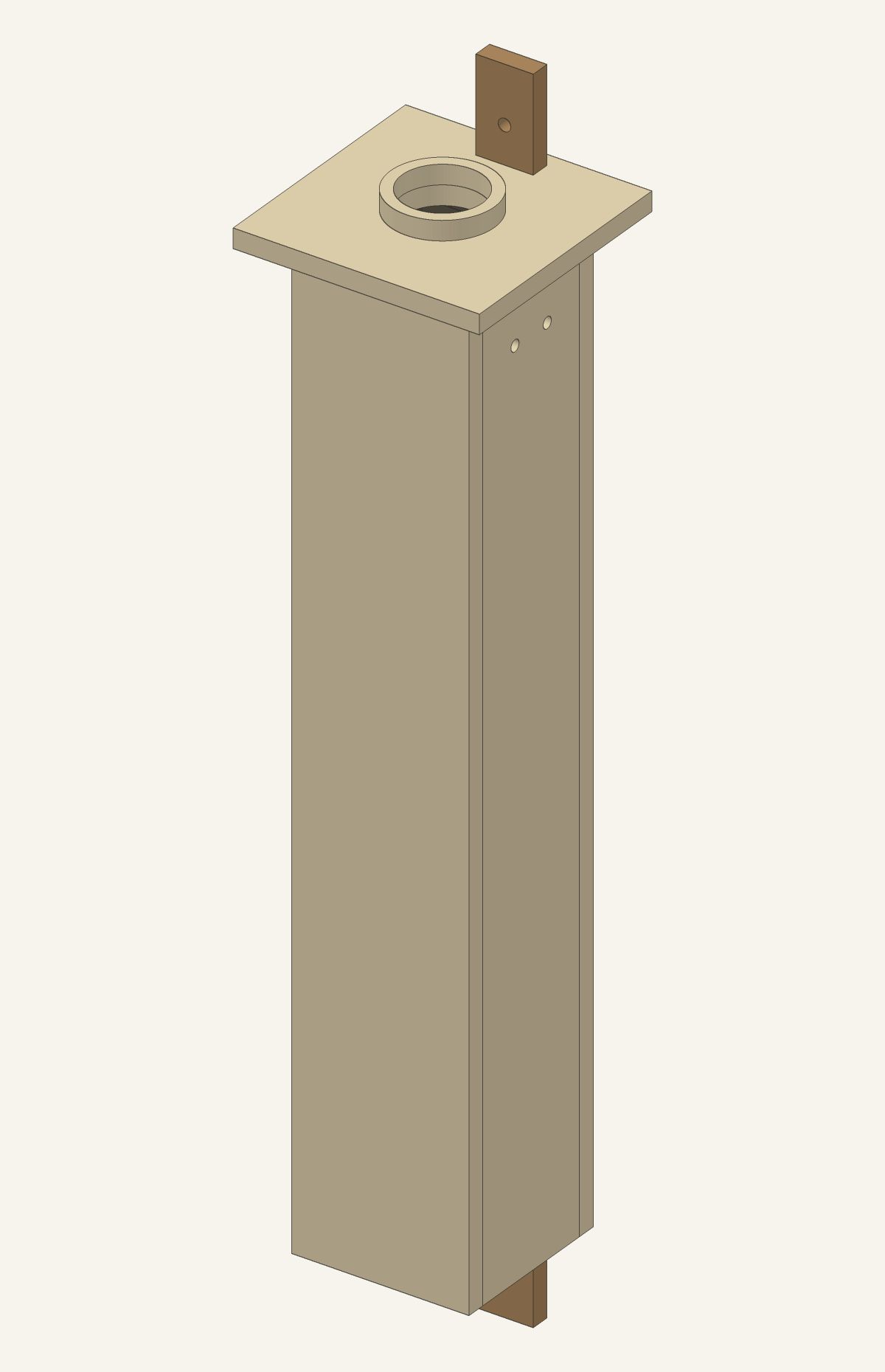
Design 3, Phascogale box, rear entry, as a turning 3D model
Design 3

Phascogale box, rear entry

For
Brush-tailed Phascogale, Krefft's Glider
Inside
200 x 200 mm, 290 high at the back
Entrance
40 mm, low in the back panel behind a corner baffle
Yield
Six to a board

The default build. A 40 mm hole low in the back panel opens into the gap behind the box, with a baffle across the corner so the animal climbs in over it while a starling finds a wall. The Broken Boosey and Whroo Goldfields pattern, where phascogales turned up at 17 of 40 sites.

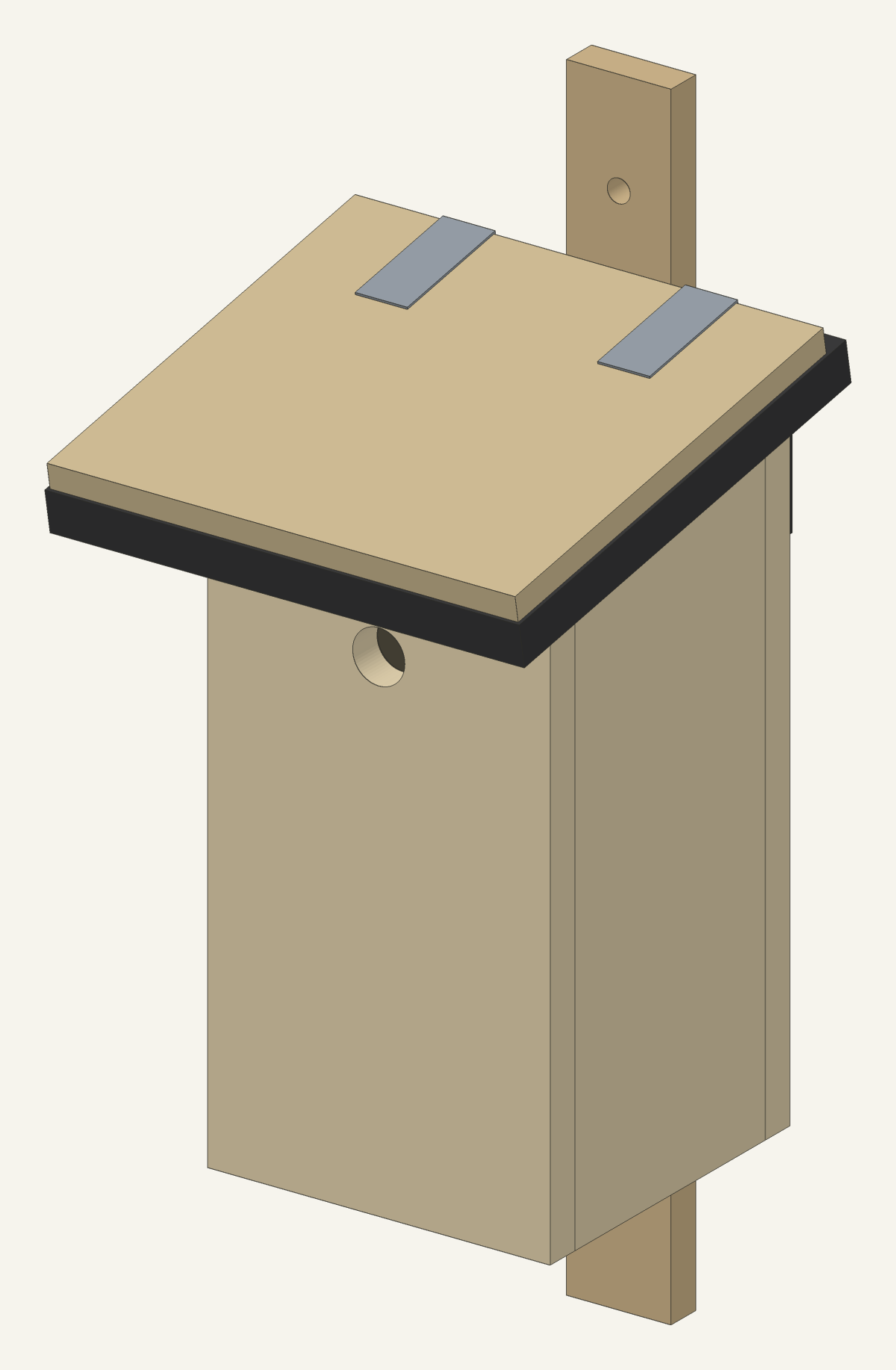
Design 2, Medium box, front entry, as a turning 3D model
Design 2

Medium box, front entry

For
Phascogale and Krefft's Glider at 40 mm, Squirrel Glider and Owlet-nightjar at 50, Red-rumped Parrot at 60, rosellas at 70
Inside
200 x 200 x 450 mm
Entrance
40, 50, 60 or 70 mm in the front
Yield
Three to a board

The same carcass at 450 high with the entrance in the front, drilled to the animal you want. Its sheet also carries the battens for a mixed board.

Design 1, Small vertical box, as a turning 3D model
Design 1

Small vertical box

For
Feathertail Glider, antechinus; Striated Pardalote with the tube
Inside
130 x 130 x 300 mm
Entrance
25 mm, or 32 mm with a 100 mm tube
Yield
Nine to a board

The smallest box, for the 10 gram glider which avoids anything with a bigger hole. Glue a 100 mm tube into the 32 mm option instead and a Striated Pardalote reads it as a burrow.

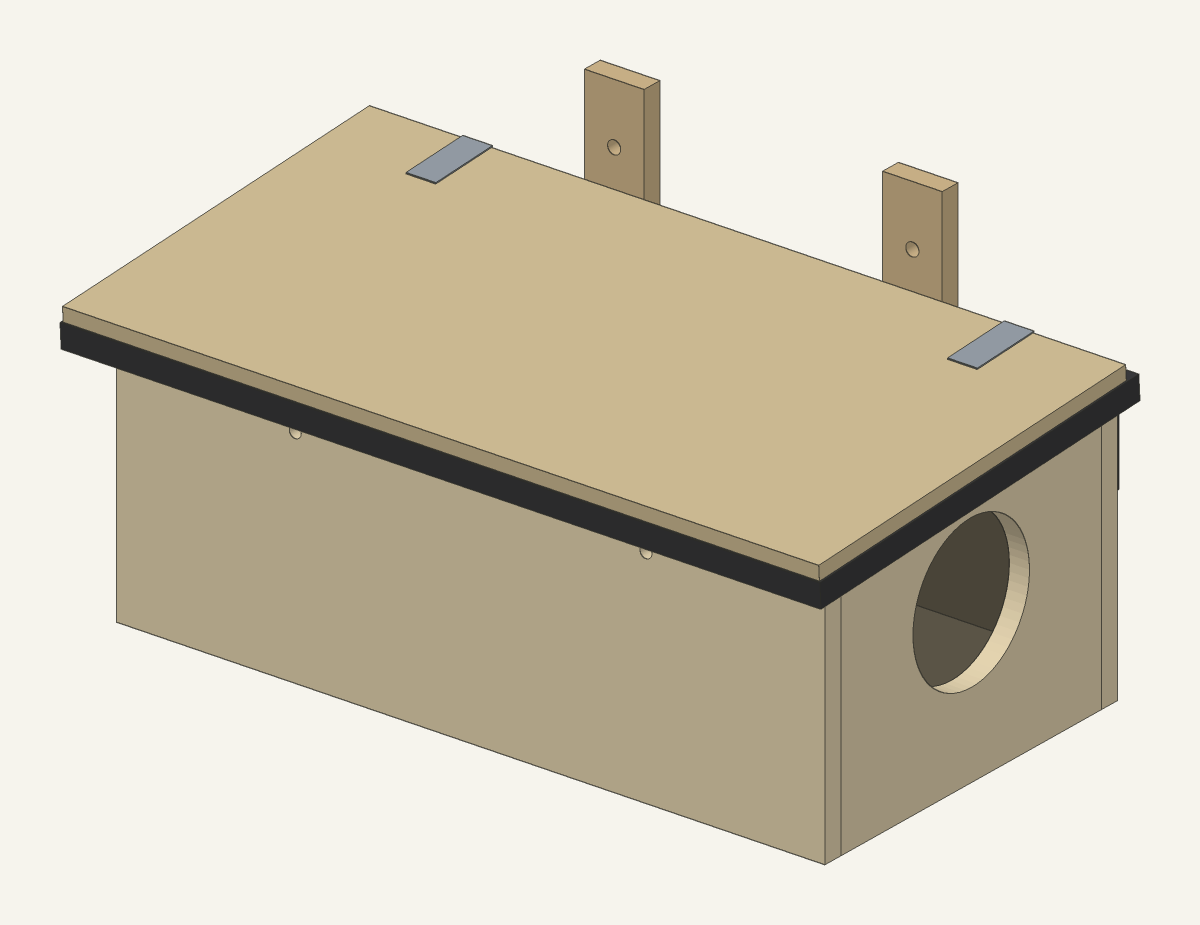
Design 5, Kookaburra box, as a turning 3D model
Design 5

Kookaburra box

For
Laughing Kookaburra; Nankeen Kestrel with the end cut open
Inside
280 x 560 x 200 mm
Entrance
125 mm in one end, over a 40 mm sill
Yield
Three to a board

A horizontal box with a sill under the entrance so the young do not foul the nest. It lies along a big limb on two battens, the entrance end tipped down to drain. Cut the top of the entrance end away for a Nankeen Kestrel.

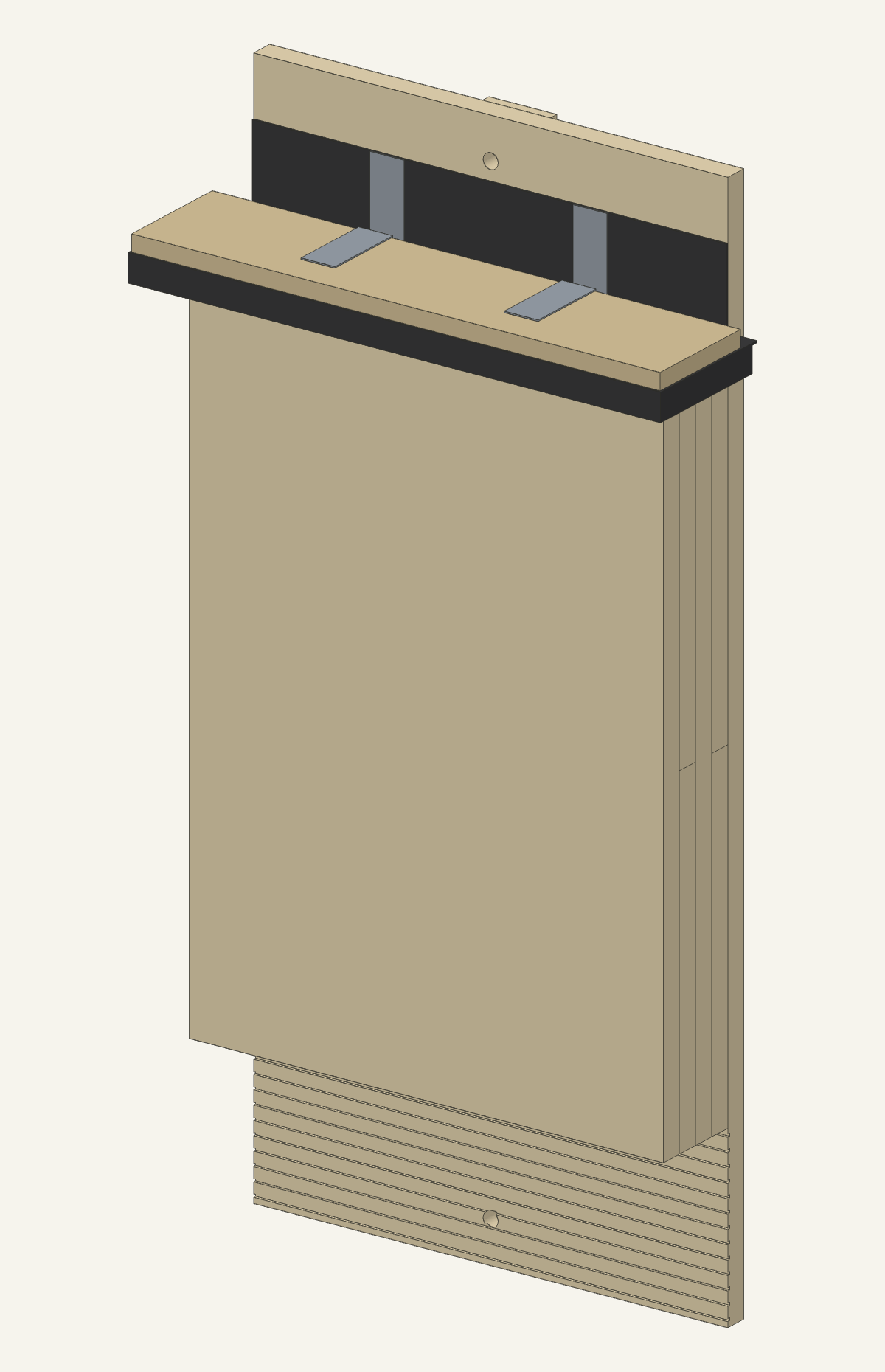
Design 7, Microbat box, as a turning 3D model
Design 7

Microbat box

For
Gould's Wattled Bat, Gould's Long-eared Bat, Lesser Long-eared Bat
Inside
Two chambers, each 250 x 500 x 17 mm
Entrance
Open at the bottom
Yield
Three to a board

Two chambers 17 mm deep between plates of the same plywood, saw kerfs on every face, a landing plate below. Goes up in threes on one tree, facing east, south and north-west. Pale paint matters most here: a dark bat box has killed thirty bats in an afternoon.

Design 8, Turquoise Parrot spout, as a turning 3D model
Design 8

Turquoise Parrot spout

For
Turquoise Parrot, for districts with the bird
Inside
120 x 120 x 800 mm
Entrance
70 mm, in the lid
Yield
Three to a board

The Goulburn Broken CMA's design: entered through the lid, climbing grooves inside, 50 mm of decayed wood in the base, and 800 mm of depth as the defence against starlings and mynas. Mounted at head height on a stump or between two star pickets in grassy box-ironbark woodland.

Fill a board

Seven board sets put three sheets on one 2400 by 1200 board, so the sheets for the animals you want print as one job. Sets A, B and C carry a Design 2 sheet with the battens for every box on the board. The others take bought hardwood battens, 42 by 19 or larger, untreated. The trim guide shows how the three sheets meet.

Three ways to build

Schools

A box built to the drawing takes a bench, a jigsaw, a drill and an afternoon. A secondary Design and Technologies class turns out a class set in a term; a primary class sands, paints and numbers what an older class cut. The education package runs from why the old trees matter through the animals, a client brief the class can argue with, the build in order, installation and monitoring, to where it sits in the Victorian Curriculum in Science, Mathematics, Design and Technologies and Geography. We come to the school with a talk pitched to the year level, supply the templates and the plywood if it is the blocker, put every box up the tree with certified people under our own insurance, and keep the monitoring record so it survives a change of teacher.

Sheds and volunteer builders

The same drawings with one page of notes in place of the classroom material, for competent adults. Rip the board into strips, jigsaw the parts, drill every hole before assembly, kerf the entrance wall, bevel the top edges so the lid beds flat, then sides, floor, baffle, front, batten, lid. A shed can also cut kits for a school to assemble. Finished boxes come to us unhung. We fit them 3 to 4 m up, in clusters of three, and record where each number went.

CNC production

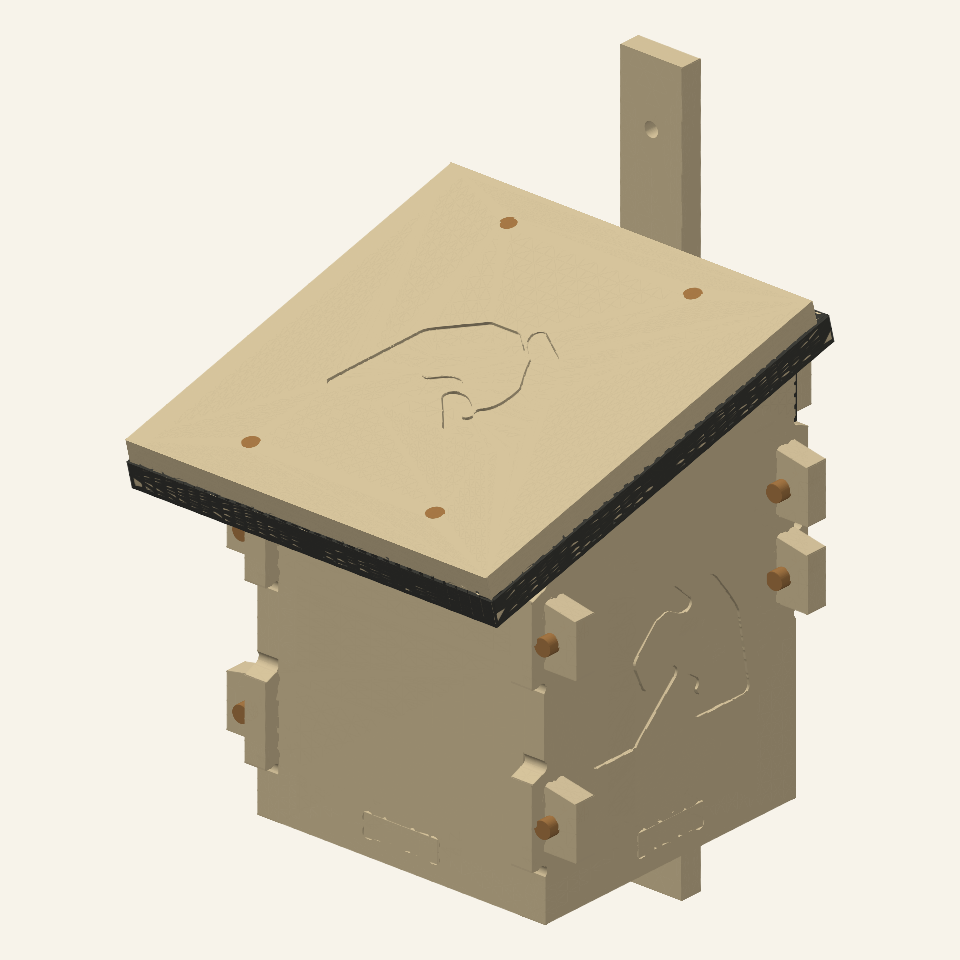
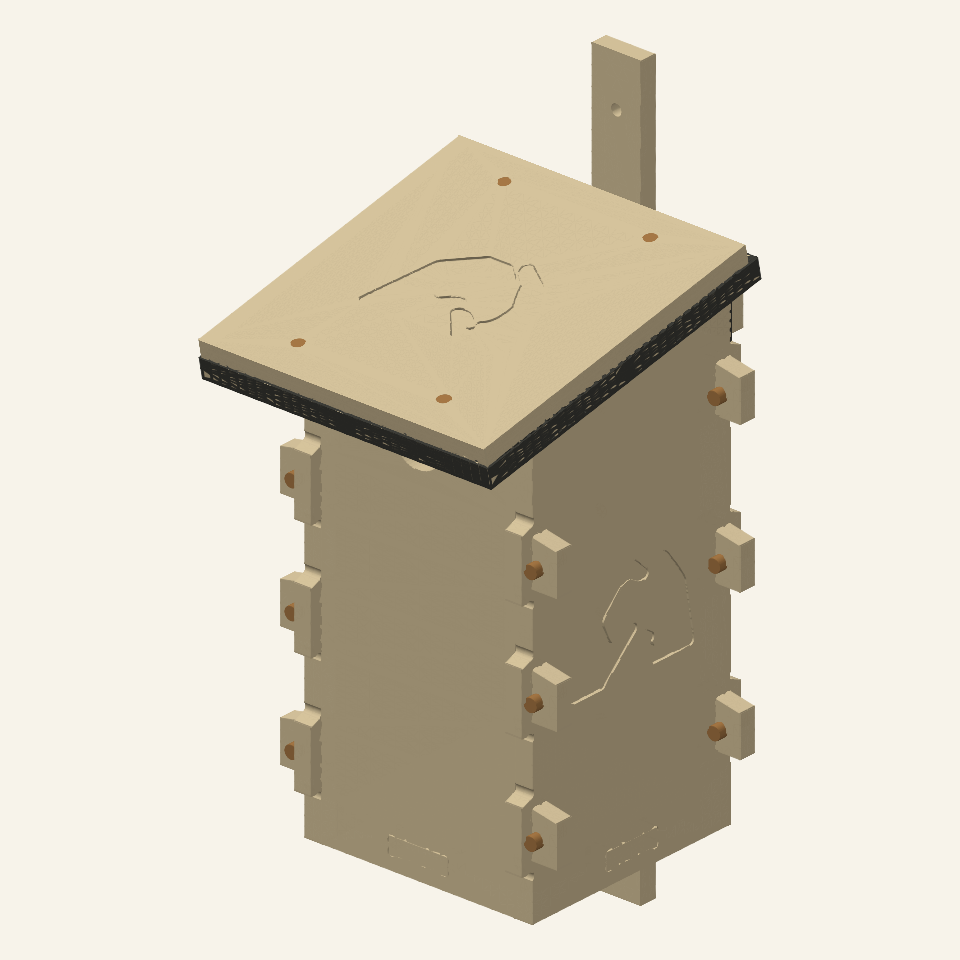
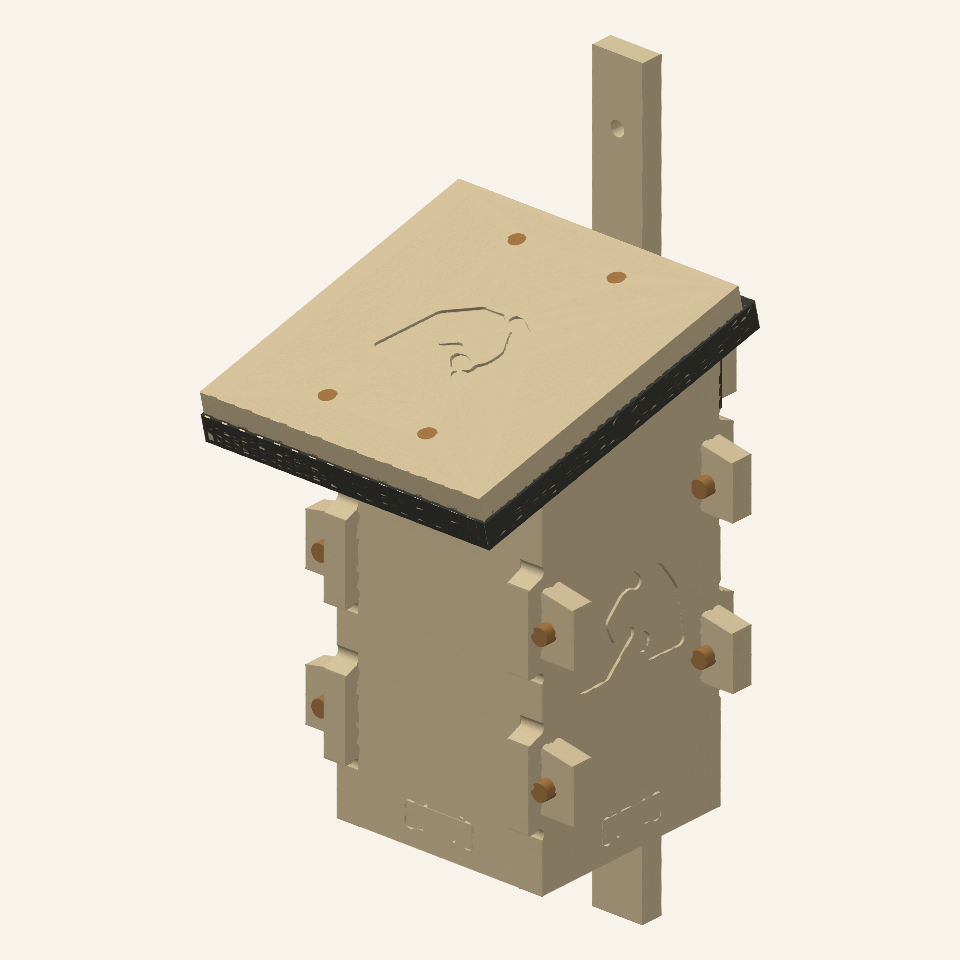
Designs 1, 2 and 3 are also drawn as DXF cutting files for a plywood shop's router: pegged joinery in place of screws, the climbing grooves and drainage machined in, the Landcare hands engraved into the sides. The shop cuts the parts; a class, a shed or a customer assembles the box with glue and a mallet. The files are drawn to the limits most CNC plywood services publish, a 9.5 mm cutter, 20 mm between parts, 17 mm marine ply. One board gives four Design 1, two Design 2 or three Design 3 boxes. A Design 1 box takes a quarter of a square metre, so it drops into the waste of most other jobs.

The pegged boxes, as the shop cuts them. Three cutting files, one board each.

The specification

Three pages: the six designs, the rules common to all of them (timber, colour, lid, floor, footholds, fixing, siting) and the fourteen published sources every dimension comes from, from Land for Wildlife Note 14 to Goldingay's 25 year survey of 303 boxes.

Tell us what you build

The templates travel. A school in another catchment prints the same sheets and buys the same board. Everything on this page is free to use, copy and adapt; credit South West Goulburn Landcare Network.

If you are planning a build or have one on the bench, ring or write. We come out to schools, collect finished boxes between Broadford and Seymour, and a photograph of a box on its tree anywhere is worth having.